
Case study · Tri Modern Health · Hoffman Estates, IL
Tri Modern Health had a traffic problem.
They just didn't know it.
On paper, Tri Modern Health (Dr. Hector Martinez's chiropractic, acupuncture, and physical-therapy practice in Hoffman Estates) had a healthy, productive website. Thousands of impressions a month, a steady stream of clicks, respectable positions in Google. Then we dug one layer deeper, and the numbers fell apart.
What the data actually said
Eight of every ten clicks weren't patients at all.
The number-one traffic source on the entire site wasn't the homepage, a service page, or a blog post. It was a PDF: a blank Spanish-language physical-therapy intake form, ranking in Google for "historia clinica fisioterapia" and collecting over 1,100 clicks in three months from people in Mexico looking for a free printable form. Not one of them will ever set foot in Hoffman Estates.
Strip that out and the picture changed completely. Of roughly 1,400 clicks the site "earned" in three months, about 278 came from anyone who could actually become a patient. In the United States, where the patients are, the site appeared in search 51,000 times and was clicked 263 times: a 0.51% click-through rate at an average position of 17. Patients weren't choosing another clinic over Tri Modern Health. They were never seeing it at all.
This is the trap of dashboard-level reporting. A template vendor sends a monthly summary that says "1,400 clicks!" and everything looks fine. Nobody checks who is clicking, or why the busiest page on a Chicago-area chiropractic site is a blank form being downloaded in another country.
The clue in the data
The one page that worked was in Spanish.
Buried in the old site's menu sat a single real Spanish-language page. That one page pulled 11,625 search impressions, more than the homepage. Around it, the search data was shouting: "quiropráctico cerca de mí" alone appeared nearly 5,000 times, hovering just off the first page of results. A large Spanish-speaking community around Hoffman Estates and Schaumburg was actively searching for a chiropractor in Spanish, and the site had almost nothing to show them.
Dr. Martinez is fully bilingual. His website wasn't. That gap (not design, not slogans) was the single biggest thing holding the practice back online.
What we did
One site, two languages, zero drift.
The rebuild made the entire site bilingual: not a translation widget bolted on top, but a true mirrored site. Every English page has a full Spanish twin, and every page tells Google exactly where its counterpart lives, so Spanish-language searches route straight to Spanish-language pages.
The part that makes it durable is the system underneath. When a new page is created, it's created in both languages at once. When an edit is made to one language, the same change lands on the other. The two halves of the site can never drift apart, which is exactly how most bilingual websites quietly die. In practice, it doubles the site's searchable surface: every service, every location, every article competes for patients in English, and again in Spanish.
And because rankings only matter if they survive the move, the migration itself was done properly: the practice's own domain and DNS brought back under its control, and every old URL mapped to its new home with a 301 redirect, so the search history Google had already granted carried across instead of starting over.
Side by side
Every page, in both languages.
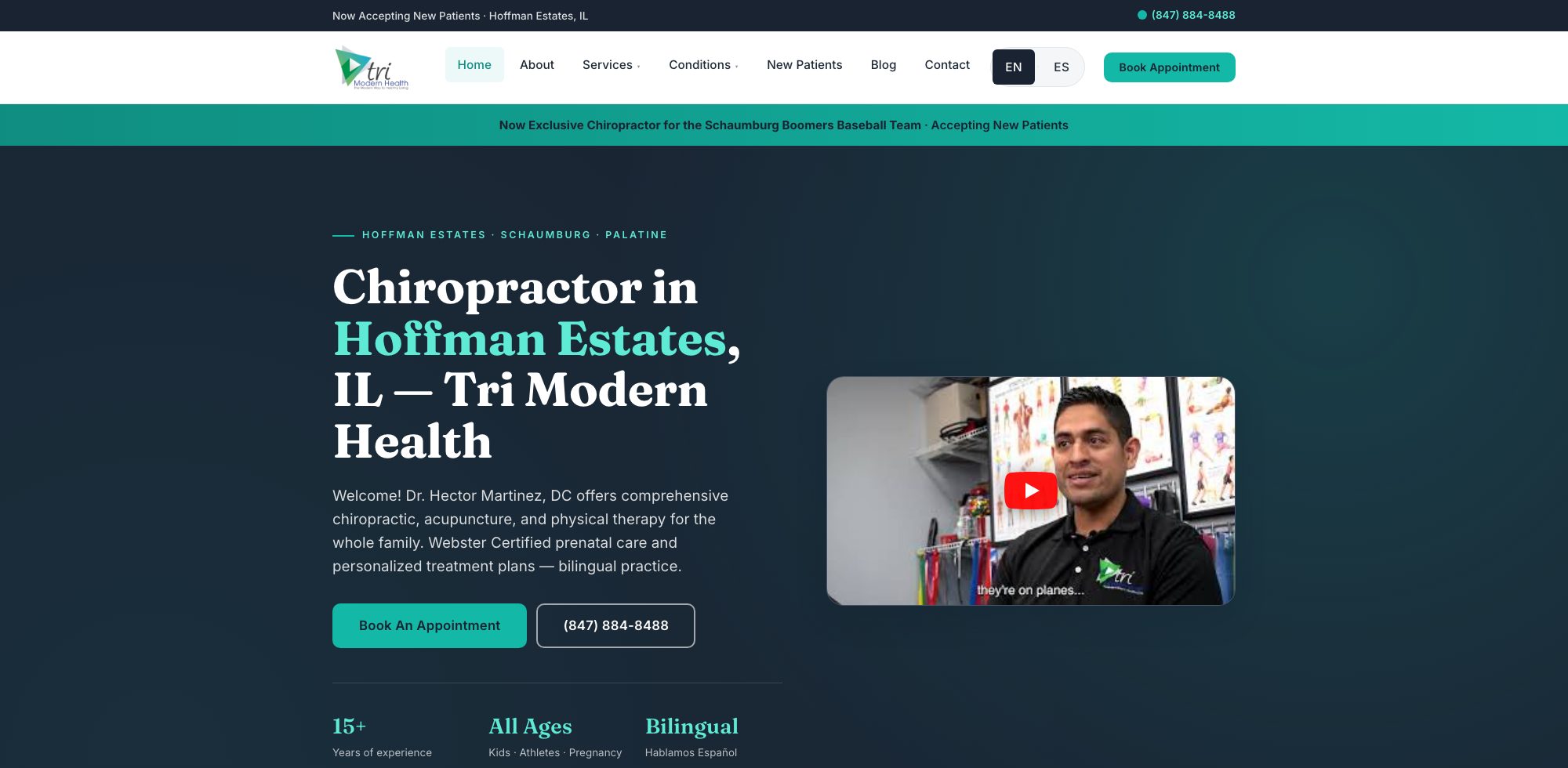
Below is the same homepage the way an English-speaking patient and a Spanish-speaking patient each find it. Same design, same information, same booking button, in the searcher's own language. This is what doubling your visibility looks like.

Graded by Google's own tool
And while we were in there, the site got twice as fast.
These are the two real Google Lighthouse mobile reports, the same benchmark Google uses to grade every website. Up top is the old iMatrix site; below it, the new PracticeFlux build. Higher is better, green is 90+, and red means Google considers it a problem.
Before · on iMatrix · May 2026
After · on PracticeFlux · July 2026
The performance score more than doubled, from a 44 Google flags in red to a 91 in the green, and best practices and SEO both climbed out of the yellow. Blocking time went from nearly two full seconds of freeze to zero, so the page loads without jumping around or locking up while a patient is trying to book.
This wasn't a one-off. Every practice we migrate gets the same before and after measurement: see the speed scores from across the fleet →
Why this matters
Visibility and speed compound.
A patient in pain, thumbing through Google on their phone, doesn't wait for a slow site; they hit back and tap the next clinic. Google knows that, which is why speed is part of how it ranks you. Now put the two fixes together: a site that finally competes for the searches its patients actually type, in both languages, served fast enough that they stay. The bilingual rankings take months to fully build: Google has to discover, index, and learn to trust the new pages. That data is being tracked now, and we'll publish it as it lands. This is the foundation it's built on.
From the founder
This is what a rebuild should feel like.
I'm a chiropractor. I built PracticeFlux because the two options our profession is handed (an expensive custom build that freezes on launch day, or a monthly template that looks like everyone else's) are both broken. Tri Modern Health is exactly the practice I built it for: real, established, and sitting on a "healthy" website nobody had ever actually looked inside. Finding the real problem in the data, fixing it, and handing back a faster site the practice actually owns is the whole point.

16 practices live across 11 states · coast to coast
Sure your traffic is real? Let's find out.
$200/month plus a one-time $595 design and onboarding fee, published right here, and I walk you through the whole move, rankings protected and nothing broken.